


Sultanate of Oman
Oman, officially the Sultanate of Oman is an Arab country on the southeastern coast of the Arabian Peninsula in Western Asia. Its official religion is Islam. Holding a strategically important position at the mouth of the Persian Gulf, the country shares land borders with the United Arab Emirates to the northwest, Saudi Arabia to the west, and Yemen to the southwest, and shares marine borders with Iran and Pakistan. The coast is formed by the Arabian Sea on the southeast and the Gulf of Oman on the northeast. The Madha and Musandam exclaves are surrounded by the UAE on their land borders, with the Strait of Hormuz (which it shares with Iran) and the Gulf of Oman forming Musandam's coastal boundaries.
Like the diversity of the environments and terrains in Oman, Omani people’s features differ as well. The desert dwellers’ features are different from those of mountain dwellers, and the features of the urban population are different from those of residents of remote villages who depend on agriculture and livestock for their livelihood.
In general, Omani features are characterized by a broad smile and the authentic Arabic generosity that is in the Omani blood. This is evident in the Omani hospitality widespread throughout the country, whether be it the aromatic Omani coffee offered to visitors or the laden palm trees that welcome anyone who wishes to taste their fruit.

His Majesty Sultan Qaboos bin Said Al Said

1940-2020 - May His Soul Rest in Peace.
Sultan Qaboos bin Said al Said was the hereditary leader of the country, which is an absolute monarchy, from 1970 until his death on 10 January 2020. His cousin, Haitham bin Tariq, was named as the country's new ruler following his death.
Sultan Qaboos bin Said al Said born on 18 November 1940 and he was a 14th-generation descendant of the founder of the House of Al Said. He was the longest-serving leader in the Middle East and Arab world, having held the office from 1970 until 2020. Sultan Qaboos was born in Salalah in Dhofar as an only son of Sultan Said bin Taimur and Sheikha Mazoon al-Mashani. Sultan Qaboos is a Muslim of the Ibadi denomination, which has traditionally ruled Oman. Although Oman is predominantly Muslim, He has granted freedom of religion in the country since his reign and has financed the construction of four Catholic and Protestant churches in the country as well as several Hindu temples.
In the 1970 Omani coup d'état, Sultan Qaboos acceded to the throne on 23 July 1970 following a successful coup against his father, with the aim of ending the country's isolation and using its oil revenue for modernization and development. He declared that the country would no longer be known as Muscat and Oman, but would change its name to "the Sultanate of Oman" in order to better reflect its political unity. The coup was supported by the British, having been planned in London by MI6 and by civil servants at the Ministry of Defence and the Foreign Office and sanctioned by the Prime Minister, Harold Wilson.
Sultan Qaboos made considerable progress in ending Oman’s isolation. He opened diplomatic relations with Oman’s neighbours, and Oman joined the Arab League and the United Nations. The country became a founding member of the Gulf Cooperation Council (GCC) in 1981, though it has resisted efforts toward military and economic unity. Notably, however, Qaboos maintained cordial relations with a wide range of countries regardless of their political alignment, including Iran, Saudi Arabia, and Israel, and navigated neutrality on a number of contentious regional issues, including Iranian nuclear ambitions, the GCC’s blockade of Qatar, and the civil war in Yemen. At times, Qaboos was able to position himself as a trusted mediator in the region’s tensest situations.
Sultan Qaboos began seeking treatment for terminal colon cancer in 2014. Because he centred the state on himself and had no children of his own, observers began to speculate about potential successors. Constitutional law dictated that the royal family would choose a successor, but, should they fail to reach a consensus, a letter left by the deceased sultan would determine the successor. In December 2019 Qaboos was treated for an illness in Belgium but unexpectedly returned just a week later, prompting rumours that he was in his final days. His death was announced on January 10, 2020, and the next day the royal family opted to open Sultan Qaboos’s envelope, which named his cousin Haitham bin Tariq as his successor.
Sultan Qaboos will long live in the hearts forever... May his soul find the mercy of God and a place in Heaven - Aameen.
His Majesty Sultan Haitham bin Tariq bin Taimur Al Said

His Majesty Sultan Haitham bin Tariq bin Taimur Al Said born 13 October 1954 is the present ruler and Sultan of Oman. He succeeded his cousin Qaboos bin Said on 11 January 2020. He previously served as Minister of Heritage and Culture in the Sultanate of Oman. Haitham bin Tariq attended Pembroke College, University of Oxford, graduating from the Foreign Service Programme (FSP) in 1979. Haitham's father was Tariq bin Taimur, son of Sultan Taimur bin Feisal. His half-brother Asa'ad bin Tariq is the deputy prime minister. He is described as "outward-looking and Western-oriented". A sports enthusiast, he served as the first head of the Oman Football Association in the early 1980s. He served as the Undersecretary of the Ministry of Foreign Affairs for Political Affairs from 1986 to 1994 and later appointed as the Secretary-General for the Ministry of Foreign Affairs (1994–2002). He was later appointed as the Minister of Heritage and Culture in March 2002 and later chaired the national census committee in 2003. He usually represented Oman abroad in a diplomatic capacity in 2016. He is also chairman of the committee for the future vision of "Oman 2040″ along with being honorary president of the Oman Association for the Disabled.
After the death of his first cousin Sultan Qaboos on 10 January 2020, Haitham bin Tariq was named by the royal family and Qaboos's will as Sultan of Oman the next day and took an oath before an emergency session of the Council of Oman in Al-Bustan. Oman state TV said the former sultan's letter was opened by the Defence Council and his identity was announced shortly thereafter. As sultan, he also holds the positions of prime minister, supreme commander of the armed forces, minister of defence, minister of finance, and minister of foreign affairs. In his first public speech, he promised to uphold his predecessor's peace-making foreign policy and to further develop Oman's economy.
Geography

Oman lies between latitudes 16° and 28° N, and longitudes 52° and 60° E. A vast gravel desert plain covers most of central Oman, with mountain ranges along the north (Al Hajar Mountains) and southeast coast (Qara or Dhofar Mountains), where the country's main cities are also located: the capital city Muscat, Sohar and Sur in the north, and Salalah in the south. Oman's climate is hot and dry in the interior and humid along the coast. During past epochs, Oman was covered by ocean, witnessed by the large numbers of fossilized shells existing in areas of the desert away from the modern coastline.
The peninsula of Musandam (Musandem) exclave, which has a strategic location on the Strait of Hormuz, is separated from the rest of Oman by the United Arab Emirates. The series of small towns known collectively as Dibba are the gateway to the Musandam peninsula on land and the fishing villages of Musandam by sea, with boats available for hire at Khasab for trips into the Musandam peninsula by sea.
Oman's other exclave, inside UAE territory, known as Madha, located halfway between the Musandam Peninsula and the main body of Oman, is part of the Musandam governorate, covering approximately 75 km2 (29 sq mi). Madha's boundary was settled in 1969, with the north-east corner of Madha barely 10 m (32.8 ft) from the Fujairah road. Within the Madha exclave is a UAE enclave called Nahwa, belonging to the Emirate of Sharjah, situated about 8 km (5 mi) along a dirt track west of the town of New Madha, and consisting of about forty houses with a clinic and telephone exchange.[68] The central desert of Oman is an important source of meteorites for scientific analysis.
History

Oman's history tells stories of heroism, courage, wisdom, patriotism, love and devotion to homeland. This brings us closer to understanding the richness of the Omani cultural experience which has contributed to the building of modern Oman. Oman’s strategic location has played a major role in many campaigns and regional conflicts in this region. Oman overlooks the Arabian Sea, the Sea of Oman and the Arabian Gulf. It also controls the Strait of Hormuz, which is one of the most important facilities in the region, linking the Sea of Oman with the Arabian Gulf. The Strait of Hormuz is a gateway to all ships coming from the Indian Ocean and Arabian Sea. Al Wattih in Muscat Governorate is one of the first inhabited cities. Modern archaeological discoveries suggest that humans settled in it during the Stone Age, i.e. more than 10,000 years ago. The Babylonians and the Assyrians settled in Oman because they wanted to control the trade route that linked Asia to the shores of the Mediterranean Sea.
At Aybut Al Auwal, in the Dhofar Governorate of Oman, a site was discovered in 2011 containing more than 100 surface scatters of stone tools, belonging to a regionally specific African lithic industry—the late Nubian Complex—known previously only from the northeast and Horn of Africa. Two optically stimulated luminescence age estimates place the Arabian Nubian Complex at 106,000 years old. This supports the proposition that early human populations moved from Africa into Arabia during the Late Pleistocene.
Economy

Oman's Basic Statute of the State expresses in Article 11 that the "national economy is based on justice and the principles of a free economy." By regional standards, Oman has a relatively diversified economy, but remains dependent on oil exports. Tourism is the fastest-growing industry in Oman. Other sources of income, agriculture and industry, are small in comparison and account for less than 1% of the country's exports, but diversification is seen as a priority by the government. Agriculture, often subsistence in its character, produces dates, limes, grains, and vegetables, but with less than 1% of the country under cultivation, Oman is likely to remain a net importer of food.
Since a slump in oil prices in 1998, Oman has made active plans to diversify its economy and is placing a greater emphasis on other areas of industry, namely tourism and infrastructure.
A free-trade agreement with the United States took effect 1 January 2009, eliminated tariff barriers on all consumer and industrial products, and also provided strong protections for foreign businesses investing in Oman. Tourism, another source of Oman's revenue, is on the rise. A popular event is The Khareef Festival held in Salalah, Dhofar, which is 1,200 km from the capital city of Muscat, during the monsoon season (August) and is similar to Muscat Festival. During this latter event the mountains surrounding Salalah are popular with tourists as a result of the cool weather and lush greenery, rarely found anywhere else in Oman.
Demographics
-
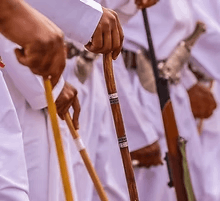
Population: Oman's population was estimated to be around 5 million people. The population has been steadily growing over the years, driven by natural growth and a small influx of expatriates for employment opportunities.
-
Ethnicity: The majority of Oman's population consists of Omanis, who are primarily of Arab descent. There are also small minorities of Baluchis, Zanzibaris, and other ethnic groups.
-
Language: Arabic is the official language of Oman, and the vast majority of the population speaks Arabic. English is also widely used and understood, especially in urban areas and among the younger population.
-
Religion: Islam is the predominant religion in Oman, and the country follows the Ibadi sect of Islam. Ibadi Islam is considered one of the main branches of Islam and has its own distinct theological and juridical traditions.
-
Age Distribution: Oman has a relatively young population, with a significant percentage of the population being below the age of 25. The government has implemented various social and economic policies to address the needs of the youth population.
-
Urbanization: The majority of Oman's population lives in urban areas, with Muscat, the capital city, being the most populous urban center. Other major cities and towns include Salalah, Sohar, and Sur.
-
Expatriate Population: Oman has a sizable expatriate population, consisting of migrant workers from various countries who come to Oman for employment opportunities in sectors such as construction, healthcare, and hospitality.
-
Literacy: Oman has made significant strides in education, and the literacy rate is relatively high, especially among the younger population.
-
It's important to note that demographic data may change over time due to population growth, migration patterns, and other factors. For the most up-to-date demographic information, it is recommended to refer to official sources such as Oman's National Center for Statistics and Information (NCSI) or other reputable demographic studies and reports.
Architecture

The evolution of architecture is a measure of a nation’s civilization and Oman abounds with a number of cultural buildings that stand as a testament to this art. As a visitor to the cities of Oman, you will surely observe the diligent efforts to preserve this ancient and traditional architecture that is characterised by its simple lines. It avoids high rises, yet maintains an understated elegance of its own. The castles, forts and walls are a testament to an architectural style that has defence in mind, the most famous being Jabreen Castle and Bahla Fort and Walls (Sur Bahla), included in the World Heritage Sites list.
Culture

Outwardly, Oman shares many of the cultural characteristics of its Arab neighbours, particularly those in the Gulf Cooperation Council. Despite these similarities, important factors make Oman unique in the Middle East. These result as much from geography and history as from culture and economics. The relatively recent and artificial nature of the state in Oman makes it difficult to describe a national culture; however, sufficient cultural heterogeneity exists within its national boundaries to make Oman distinct from other Arab States of the Persian Gulf. Oman's cultural diversity is greater than that of its Arab neighbours, given its historical expansion to the Swahili Coast and the Indian Ocean.
Oman has a long tradition of shipbuilding, as maritime travel played a major role in the Omanis' ability to stay in contact with the civilisations of the ancient world. Sur was one of the most famous shipbuilding cities of the Indian Ocean. The Al Ghanja ship takes one whole year to build. Other types of Omani ship include As Sunbouq and Al Badan.
In March 2016 archaeologists working off Al Hallaniyah Island identified a shipwreck believed to be that of the Esmeralda from Vasco da Gama's 1502–1503 fleet. The wreck was initially discovered in 1998. Later underwater excavations took place between 2013 and 2015 through a partnership between the Oman Ministry of Heritage and Culture and Blue Water Recoveries Ltd., a shipwreck recovery company. The vessel was identified through such artifacts as a "Portuguese coin minted for trade with India (one of only two coins of this type known to exist) and stone cannonballs engraved with what appear to be the initials of Vincente Sodré, da Gama's maternal uncle and the commander of the Esmeralda."

Explore the Beauty
W
H
Y
O
M
A
N
-
Oman is a hidden gem in the Arabian Peninsula that offers a unique and compelling vacation destination for travelers seeking an authentic and enriching experience.
-
Rich Cultural Heritage: Oman boasts a fascinating history that dates back thousands of years, with a vibrant cultural heritage shaped by maritime trade, Islamic traditions, and Bedouin customs. Visitors can explore ancient forts, archaeological sites, and traditional souqs, gaining insights into Oman's storied past and the enduring customs of its people.
-
Diverse Landscapes: Oman's storied past and the enduring customs of its people. Oman's diverse landscapes are a testament to the country's natural beauty. From the majestic mountains of Jebel Akhdar and Jebel Shams to the golden sands of the Wahiba Sands desert, and from the lush greenery of Salalah during the Khareef season to the turquoise waters of the Arabian Sea along the coast, Oman offers a rich tapestry of scenery waiting to be explored.
-
Adventure Opportunities: For adventure enthusiasts, Oman provides a wide array of thrilling activities. From trekking through wadis and hiking in canyons to dune bashing in the desert and diving in pristine waters, there is something for everyone seeking an adrenaline rush and a connection with nature.
-
Warm Hospitality: Omani hospitality is legendary, and visitors to Oman are welcomed with genuine warmth and friendliness. Whether staying in a luxury resort or experiencing traditional Omani hospitality in a mountain village, you will feel like part of the Omani family, making your vacation all the more memorable.
-
Safety and Peacefulness: Oman is known for its safety and security, making it an ideal destination for families, solo travelers, and couples alike. The country is known for its peaceful atmosphere and low crime rates, allowing visitors to explore with peace of mind.
-
Authentic Arabian Experiences: Unlike some of the more commercialized destinations in the region, Oman offers an authentic Arabian experience. Traditional customs and practices are still very much alive, and the country has managed to retain its cultural integrity while embracing modernity.
-
Unspoiled Beauty: Oman's commitment to sustainable tourism has preserved much of its unspoiled beauty. From pristine beaches to untouched desert dunes and rugged mountains, Oman provides a chance to connect with nature in its purest form.
-
Rich Marine Life: For diving and snorkeling enthusiasts, Oman's coastline is a treasure trove of marine life and vibrant coral reefs. Explore the underwater world and encounter an abundance of marine species in crystal-clear waters.
-
Relaxed Atmosphere: Oman's unhurried pace of life allows travelers to immerse themselves in a more laid-back environment, where they can unwind, rejuvenate, and truly connect with the beauty of the surroundings.
Whether you seek cultural exploration, outdoor adventures, or simply a peaceful escape from the hustle and bustle, Oman offers a diverse and soul-enriching vacation experience that will leave you with unforgettable memories and a deep appreciation for the splendors of this enchanting country.
Know the Hospitality


